2026 Best Zirconia Rods for Industrial Applications
Selecting the best Zirconia Rods for industrial applications in 2026 requires more than comparing catalog strength figures. The right choice depends on operating temperature, chemical exposure, load, and the precision your equipment needs. A rod inside a kiln fixture faces different demands from one used in a pump assembly or a wear component.
Materials scientist R.C. Garvie and coauthors captured zirconia’s distinctive promise in their landmark paper title, “Ceramic steel?” Their research helped bring attention to zirconia’s transformation-toughening behavior. The phrase is memorable, but it is not a product guarantee. Performance varies with composition, manufacturing quality, and service conditions.
This guide compares practical selection factors: zirconia grade, dimensional tolerance, surface finish, thermal stability, and resistance to wear. A small difference in diameter can affect fit. A rough surface may matter in a precision assembly. Ask suppliers for grade-specific technical data, tolerances, and test conditions, rather than relying on broad claims. Where possible, match those details against your actual operating environment. That takes time. It is still better than choosing by price alone.
No single rod is best for every plant. Even a well-documented specification may not capture every real-world variable. The comparison ahead aims to make trade-offs clearer, while leaving room for application testing and careful review.
Zirconia Rod Grades: 3Y-TZP, 4Y-PSZ, and 8Y-YSZ
Zirconia rods are not interchangeable. Their yttria content changes strength, translucency, and electrical behavior. For demanding wear parts, 3Y-TZP is often the mechanical benchmark. A 2020 review in Materials reports typical flexural strength of roughly 900–1,200 MPa and fracture toughness of 5–10 MPa√m for 3Y-TZP. These are reported ranges, not guaranteed values for every rod; porosity, grain size, and machining damage matter.
4Y-PSZ offers a practical middle ground. Its higher cubic-phase content improves light transmission, while its strength and crack resistance generally fall below 3Y-TZP. That trade-off can suit precision guides or components where appearance and moderate loading both matter. Check test conditions carefully. Flexural strength figures can shift with specimen shape and surface finish.
8Y-YSZ contains still more yttria and has a larger cubic-phase fraction. It generally favors optical transmission and high-temperature oxygen-ion conduction over maximum fracture toughness. A technical review by Steele and Heinzel in Nature (2001) discusses YSZ’s role as an oxygen-ion conductor in fuel-cell materials. For rods near hot process zones, that property may matter; for impact-prone fixtures, it may not. One uncomfortable detail: “8Y” alone does not predict service life. Ask for thermal-cycle, density, and finished-surface data, then test a rod under the actual load.
Performance Metrics: 900–1,200 MPa Strength and 6–10 MPa·√m Toughness
For high-performance stabilized zirconia, 900–1,200 MPa flexural strength and 6–10 MPa·√m fracture toughness are useful screening ranges, not guarantees. A 2007 Journal of the American Ceramic Society review by Chevalier, Gremillard, and Deville discusses the transformation-toughening behavior of 3Y-TZP. Strength can be assessed using flexural methods such as ASTM C1161, while ASTM C1421 covers fracture-toughness testing. Test conditions matter. These figures depend on composition, grain structure, finish, and specimen geometry.
For a rod, surface quality is not cosmetic. A long, ground rod with a fine machining line may behave differently from a polished test coupon. Small flaws count. Ask for lot-specific test results and confirm that the reported strength is flexural, not tensile; compare results only when methods match. Temperature changes, water exposure, and repeated loading may also affect service performance, so the highest quoted value is not automatically the best choice. I would treat the 6–10 MPa·√m range as a useful guide, then check whether the test method reflects the rod’s actual working conditions. That extra check can feel tedious, but skipping it leaves a real gap.
2026 Best Zirconia Rods for Industrial Applications - Performance Metrics: 900–1,200 MPa Strength and 6–10 MPa·√m Toughness
Representative properties for dense 3Y-TZP zirconia; actual values depend on composition, processing, specimen geometry, and test method.
| Performance metric |
Representative value |
Unit / condition |
Industrial relevance |
| Flexural strength |
900–1,200 |
MPa; representative room-temperature range |
Supports load-bearing designs; verify using the finished rod geometry and surface condition. |
| Fracture toughness |
6–10 |
MPa·√m; method-dependent |
Indicates resistance to crack propagation; compare results only when test methods are comparable. |
| Bulk density |
Approximately 5.9–6.1 |
g/cm³ |
Useful for estimating component mass and checking material consistency. |
| Vickers hardness |
Approximately 1,200–1,300 |
HV; depends on indentation load and surface preparation |
Relevant to abrasion and indentation resistance; hardness alone does not predict wear life. |
| Elastic modulus |
Approximately 200–210 |
GPa |
High stiffness helps limit elastic deflection in precision guides and support components. |
| Coefficient of thermal expansion |
Approximately 10–11 |
×10⁻⁶ K⁻¹; approximate range over 20–800°C |
Important when matching rod dimensions and thermal expansion to adjoining components. |
| Thermal conductivity |
Approximately 2–3 |
W/(m·K); near room temperature |
Relatively low conductivity can affect heat removal and thermal gradients in service. |
| Typical rod applications |
Wear pins, pump or valve components, guides, spacers, and electrical-insulation parts |
Select the grade and dimensions for the specific load, temperature, environment, and tolerances. |
Values are indicative material-property ranges, not guaranteed design values. Flexural strength and fracture toughness depend on specimen preparation, test configuration, surface finish, and material grade; confirm supplier data and validate the finished rod under its intended service conditions.
Thermal Limits: 2–3 W/(m·K) Conductivity and Thermal-Shock Resistance
2026 Best Zirconia Rods for Industrial Applications
A conductivity of 2–3 W/(m·K) makes zirconia a useful thermal barrier, not a fast heat spreader. Touloukian and colleagues’ Thermophysical Properties of Matter compilation shows why ceramic values must be tied to composition and temperature. Stabilized zirconia commonly sits near this range at room temperature, but porosity and stabilizer content shift the result.
Small detail.
A rod’s measured conductivity may also differ from a supplier’s idealized material value.
Thermal-shock resistance is not captured by conductivity alone. Kingery’s classic analysis of ceramic thermal stress links performance to conductivity, expansion, elastic modulus, strength, and geometry. In practice, a thick rod heated on one end can develop a sharp temperature gradient, even when its surface seems intact. A slower ramp and uniform heating reduce that risk.
Not always enough.
Machining marks, tight mounting, or uneven cooling can still initiate cracks. For industrial selection, request test data at the intended temperature and inspect the actual rod dimensions, not just a generic zirconia grade. A small pilot cycle is often more informative than a confident datasheet line.
Rod Dimensions: Match Diameter, Tolerance, and Finish to Operating Loads
2026 Best Zirconia Rods for Industrial Applications
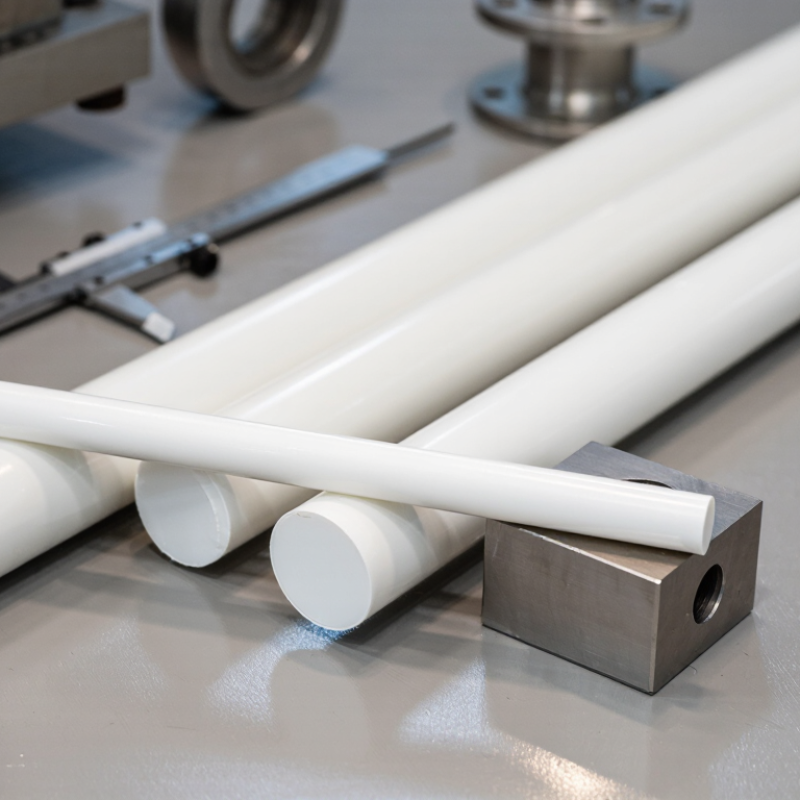
Rod dimensions should follow the load path, not just the available space. A rod under bending needs a diameter suited to its unsupported span, side load, and mounting method. Even a small increase in diameter can improve stiffness, but it may also require larger bearings or tighter assembly clearances. Specify the working length and diameter together. For sliding or press-fit parts, confirm the mating component’s dimensions and thermal conditions before setting tolerance. A neat drawing is not enough if the assembled rod binds when warm.
Tips: Record the load, temperature, span, and fit before requesting a quote. Ask how diameter tolerance is measured, and whether inspection covers the full rod length. A sample fit can reveal problems early.
Surface finish matters where the rod contacts seals, guides, or other ceramic parts. A smoother finish may reduce friction, but it does not compensate for poor alignment or edge damage. Specify a finish appropriate to the contact and wear conditions, and identify any chamfers or polished zones. Inspect ends and edges after handling; small chips can become failure points under repeated stress. In practice, test the selected dimensions in the actual mounting setup. That step can feel slow, and it is easy to skip. Don’t.
Industrial Uses: Wear Parts, Furnace Fixtures, and Precision Components
2026 Best Zirconia Rods for Industrial Applications
Zirconia rods serve in wear parts, furnace fixtures, and precision components where steel may wear quickly or contaminate a process. In sliding assemblies, their hardness and corrosion resistance can help maintain dimensions. The trade-off is brittleness: a sharp impact or poorly supported rod can cause sudden failure. For furnace fixtures, zirconia’s low thermal conductivity can reduce heat transfer, but steep temperature gradients still create stress. In precision applications, ground rods can support repeatable alignment, provided diameter tolerance and surface finish match the assembly.
Material selection needs measured evidence, not just a strength headline. Kelly and Denry’s 2008 review in Dental Materials reports flexural strengths around 900–1,200 MPa for some zirconia ceramics. Those figures describe specific ceramic grades and test conditions, not a guarantee for every industrial rod. ASTM C1161 provides a standard method for measuring ceramic flexural strength. Check grade, test data, operating temperature, and the supplier’s dimensional tolerances. A shortcut worth questioning: choosing the hardest grade alone may overlook thermal shock and mounting stress.
Tips: For furnace fixtures, allow room for expansion and avoid point loading. For wear parts, inspect contact edges for chips. For precision rods, specify straightness and diameter tolerance; a small mismatch can become costly during assembly. Test the actual load cycle when possible. Real service conditions can be messier than the drawing.
2026 Best Zirconia Rods for Industrial Applications
Typical flexural strength ranges for zirconia grades used in wear parts, furnace fixtures, and precision components.
3Y-TZP is often selected for demanding wear applications, while 4Y- and 5Y-TZP grades can suit precision components. 8YSZ is commonly used where thermal stability or oxygen-ion conductivity is important. Values are indicative typical ranges; actual properties vary with composition, processing, and test method.